How CAS Works
Our approach is unique aenean ultrices augue eget ullamcorper lacinia. Fusce at placerat lacus. Etiam consequat lobortis tincidunt

Schools who choose to engage in CAS go through an onboarding process. This involves signing up to the CAS principles of working, choosing an in-school CAS, engaging in training and delivering a whole-school CAS workshop. Once onboarded, Schools engage in the CAS annual four-step professional development cycle. Click on the different stages of the CAS annual cycle to find out further detail.
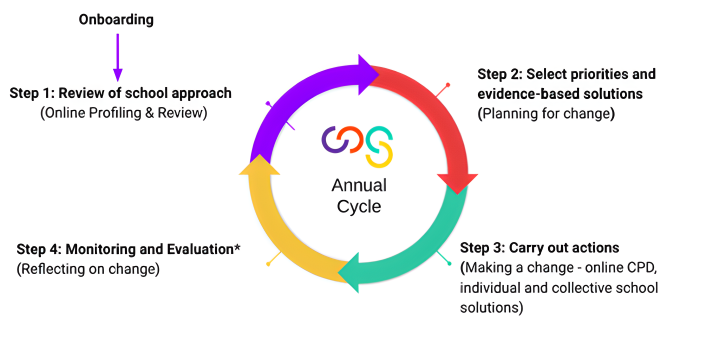
- Review (May to June): In-school CAS lead uses online profiling tool to assess current whole-school PA provision against four areas: policy, environments, stakeholders and opportunities.
- Action planning (June to Sept): Twenty-two online CPD modules support In-school CAS lead to select priority improvement areas and complete planning for change documents. Actions integrated into the school improvement plan.
- Implementation (Sep to July): Schools deliver planned actions, supported by the CAS Champion through training opportunities and shared learning with other schools.
- Monitoring and Evaluation (ongoing): Schools evaluate the impact of chosen initiatives. These insights inform the next CAS profiling exercise, starting a new annual cycle.
How CAS Works for Schools
The Creating Active Schools programme aims to positively change whole-school culture and ethos around physical activity provision. Through the CAS annual cycle schools are supported to integrate physical activity design, delivery and monitoring into whole school improvement plans. As a result, the CAS programme improves outcomes for schools, children and young people beyond wellbeing such as academic performance, attendance, behaviour and teaching and learning. OFSTED and the Department for Education have both recognised the value of the Creating Active Schools programme in achieving these outcomes.
Further outcomes identified in both research and practice show the CAS programme to support:
- The inclusion and improvement of physical activity within the whole-school culture and ethos.
- Teachers and wider school staff to promote and deliver physical activity.
- The integration of physical activity within academic lessons.
- Improvements in Physical Education curriculum delivery.
- Whole-school stakeholder behaviours towards physical activity (capability, opportunity and motivation).
- OFSTED inspections, particularly deep-dives into Physical Education and physical activity.
- Effective expenditure of the PE and Sport Premium.